About this time of year, every year, I realize it’s time to organize my writing life. As much as I try to stay on task and keep focused and goal-oriented, invariably, life has other things in mind. This is especially the case when you’re not a “full-time” writer but have a myriad of other things to juggle—maybe a family, a job, a household, or all of the above.
So, let’s talk about ways to organize your writing life and stay organized as a writer.
You don’t need me to tell you that, as a writer, staying organized is vital for maintaining productivity, not to mention being creative. It’s hard to harness those creative vibes when my surroundings are a mess, and it’s almost impossible to be productive if I don’t even know where my writing projects are or what I plan to work on that day!
Whether you’re a novelist, journalist, blogger, or content creator, keeping your thoughts, ideas, and projects in order can significantly impact your work.
Here are a few effective tips for organizing your life as a writer. Some are things I’ve learned in my fifteen years of writing and freelancing as an editor for other writers. Other writing organization tips are things I’m trying to adopt this year to be more effective in my writing in the year to come.
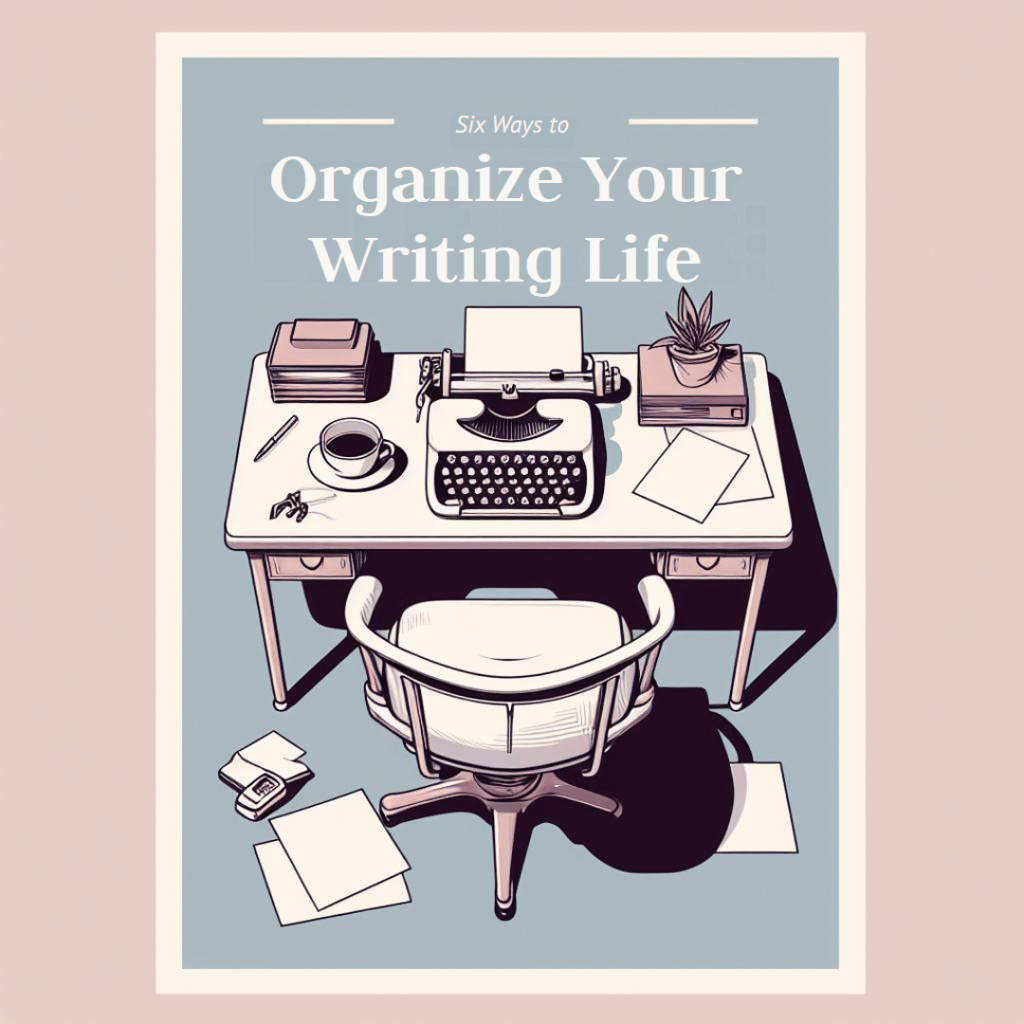
Organize Your Writing Tip #1: Designate a Writing Space
I was going to talk about making time for writing first but decided to start with a space for writing instead. Really, both of these are vitally important, and they go hand in hand.
When it comes to a space for writing, you want to create a designated writing area. Ideally, this writing space will be free from distractions. If not entirely free from distractions, at least there will hopefully be stretches of time when it’s quiet and you’re able to focus.
I know how hard this can be if you’re a work-from-home mom, for instance, who fits writing time in little bursts of time that are always briefer than you would like. (In some ways, this makes it even more important to have your own little space where you can sit and focus on your writing when you have that time to write!)
Especially if your writing area is small, you’ll want to keep that space organized with the help of desk organizers or storage bins.
Interior décor has never been a strong point for me, but it’s nice to have a space that has a nice aesthetic as well as being practical. That’s something I plan on working on this year. You can browse Pinterest for ideas on writing spaces in a variety of styles. Invest in one or two things that make the writing space unique and special for you. (I love this cute pencil holder that looks like old books.)
Make sure you have a comfortable chair and good lighting to make your writing environment conducive to creativity. For me, having a space near a window or that is outside yet sheltered is a great way to invite the creativity that is borne of nature.

Writing Organization Tip #2: Create a Writing Schedule
Okay, now let’s talk about time. This is easier in some situations than others, but here’s the main gist: you’ll need to set aside dedicated time for writing each day or week. Some well-known authors are known to have written every single day, but that doesn’t work for everyone. You might have a packed schedule during the weekdays, so it wouldn’t be realistic to write every day. So, add it to your schedule for the weekend.
The key is, put it on your schedule and keep that writing appointment like you would keep any other appointment. Use a physical planner or digital calendar to schedule those writing sessions and any writing deadlines you have given yourself.
In past years, I created schedules on a Word document or in Excel. More often than not, I’d forget about the calendar until the next season. This year, I’m trying something different and putting my schedule on my Google calendar with reminders set for my writing time.
Tip #3: Develop a System for Ideas and Research
If you’re a writer, you know that ideas and inspiration come at the weirdest times, often unbidden. So, keep a writing notebook or digital note-taking app to jot down those ideas as they come. (I like this writing notebook as it’s compact, stylish, and has a bunch of pages for all those random story ideas!)
What I use most of the time, though, is the speech-to-text tool in Gmail. Seriously, while driving on my own, I often have a bunch of ideas, and it’s unrealistic to keep pulling to the side of the road to jot down those thoughts; I’d never reach my destination. So, before backing out of the driveway, I open my Gmail app and start an email to myself. Then, I press the dictate button and start talking. The voice-to-text isn’t perfect, but it’s enough to track my general thoughts or draft an outline of something. I hit send once I arrive at my destination.
Then, once I’m back at my computer, I’ll copy the email and paste it wherever it belongs. (That’s the next point.)
Tools like Evernote or OneNote can help you organize research materials and references, while mind-mapping books or tools like MindMeister or XMind can assist you in visualizing and organizing your thoughts.

Tip #4: Organize Your Writing Projects
These days, there are plenty of project management tools like Asana or ClickUp that can help you manage your writing projects, especially if you are also a freelance writer and/or editor and have multiple tasks and deadlines for clients.
I use ClickUp regularly with one client and Asana with another, both of whom are writers and content providers in the realm of digital information and technology, and these tools are necessary and helpful.
For my personal writing projects, though, I organize them into folders on my computer. I have one main “writing” folders, and within that folder, I have a number of folders, including “books – fiction,” “books – nonfiction,” “poems,” “journaling,” and so on.
Then, in my “books – fiction” folder, as an example, I have folders with the genre of the books I’m writing such as “suspense,” “literary fiction,” and “fantasy and speculative.” (Yes, I write in a lot of genres.) Within those folders are Word documents for each of the manuscripts I’m working on.
It might be clunky for some, but it works for me. Other writers organize their writing using cloud storage services like Google Drive or Dropbox. Sometimes I’ll back up the manuscript I’m currently working on in Dropbox or Google Drive. Then I regularly back up my entire writing folder into a separate hard drive, just in case.
You might also consider using writing software like Scrivener or Ulysses, which offer features for organizing and structuring long-form writing projects. I have used both Scrivener and Obsidian for my writing projects at various times.
Organize Your Writing Tip #5: Create (and Meet) Deadlines
Create a calendar or timeline for your writing projects, including deadlines for drafts, revisions, and final submissions. Then, set up reminders or alerts using calendar apps or task management tools to keep reminding yourself about upcoming deadlines.
Of course, we all know that life can get in the way of our best intentions, but when you treat this writing like not just a hobby that it would be nice to do “if you ever find the time” but an actual job with deadlines, you’re more likely to see yourself making progress on that writing.
There are time-tracking tools like Toggl or RescueTime to help you monitor your writing progress and stay accountable. Or just create your own calendar in Excel and track your time manually.
Tip #6: Weave Breaks and Self-Care into Your Writing Life
Schedule regular breaks during your writing sessions. This will help you maintain focus and higher productivity when you write. What this looks like will be unique to your writing style and your particular schedule.
For example, perhaps your schedule allows you long stretches of writing, in which case you might want to take a ten-minute break in which you fix yourself a cup of tea (coffee, if you prefer), or take a brisk walk, or do a short meditation practice.
If you have limited writing time, then your “writing self-care routine” might look different. Maybe you’ll fix that cup of tea before you sit down to write. Or light a candle and have it burning gently in your writing corner. (Lavender candles have been my favorite for a while, but then I recently discovered honey candles, and use those while I write as well, depending on the mood.)
Some writers use the Pomodoro Technique, which is 25-minute stretches of work (aka writing), with five-minute breaks in between. And then, after several of these writing stints, you take a longer break of 15 minutes to half an hour. Practicing some form of time-blocking can help you structure your writing sessions and breaks effectively.
You might also want to incorporate other activities into your routine, such as art or similar creative hobbies, to recharge your creativity.
Another important part of writing self-care is to celebrate your wins, even the small ones!
Did you reach your writing goals all week long? Did you get a poem or short story accepted? Treat yourself to a reward of some sort, maybe gourmet chocolate or a type of tea that you save for special occasions.

Help as you Organize Your Writing Life
Here’s a brief list of some of the suggestions mentioned throughout this post, along with a few other recommendations for organizing your life as a writer. Do some research and experiment to find out what works for you!
- Planner: Moleskine Weekly Planner
- Digital Calendar: Google Calendar
- Productivity Apps: Todoist, Trello
- Desk Organizer: Mesh Desk Organizer
- Note-taking App: Evernote, OneNote
- Mind-mapping Tool: MindMeister, XMind
- Project Management Tool: Asana, ClickUp
- Cloud Storage Service: Google Drive, Dropbox
- Writing Software: Scrivener, Ulysses
- Time-tracking Tool: Toggl, RescueTime
Organizing your life as a writer will look different for you than it looks for me. It will also look different for you this year than it looked last year, or maybe even last month. Things change and all we can do as writers and creatives is the best we can with what we have.
But it does help to create some type of structure and routine into your writing life. It is also beneficial to maintain a clutter-free workspace, find effective ways to manage your ideas and projects, and take care of your well-being as a writer—your mind and soul. I’d love to hear what writing practices work for you, as well as what writing goals you have for the year ahead!
You might also enjoy:
 Bonita Jewel
One thought on “Six Ways to Organize Your Writing Life”
Comments are closed.